Basic Policy
KYB sets ESG management as the foundation of its policy development. We are not only responding to environmental needs, but also promoting the development of products that contribute to a sustainable society and connecting the resulting business opportunities to an increase in corporate value. Our ESG Promotion Dept. is at the forefront of developing basic environmental, social, and governance policies enacted throughout the Group. In addition, we are building trust through collecting data on all of our in-house ESG initiatives and fulfilling our reporting accountability to our stakeholders.
ESG Promotion System
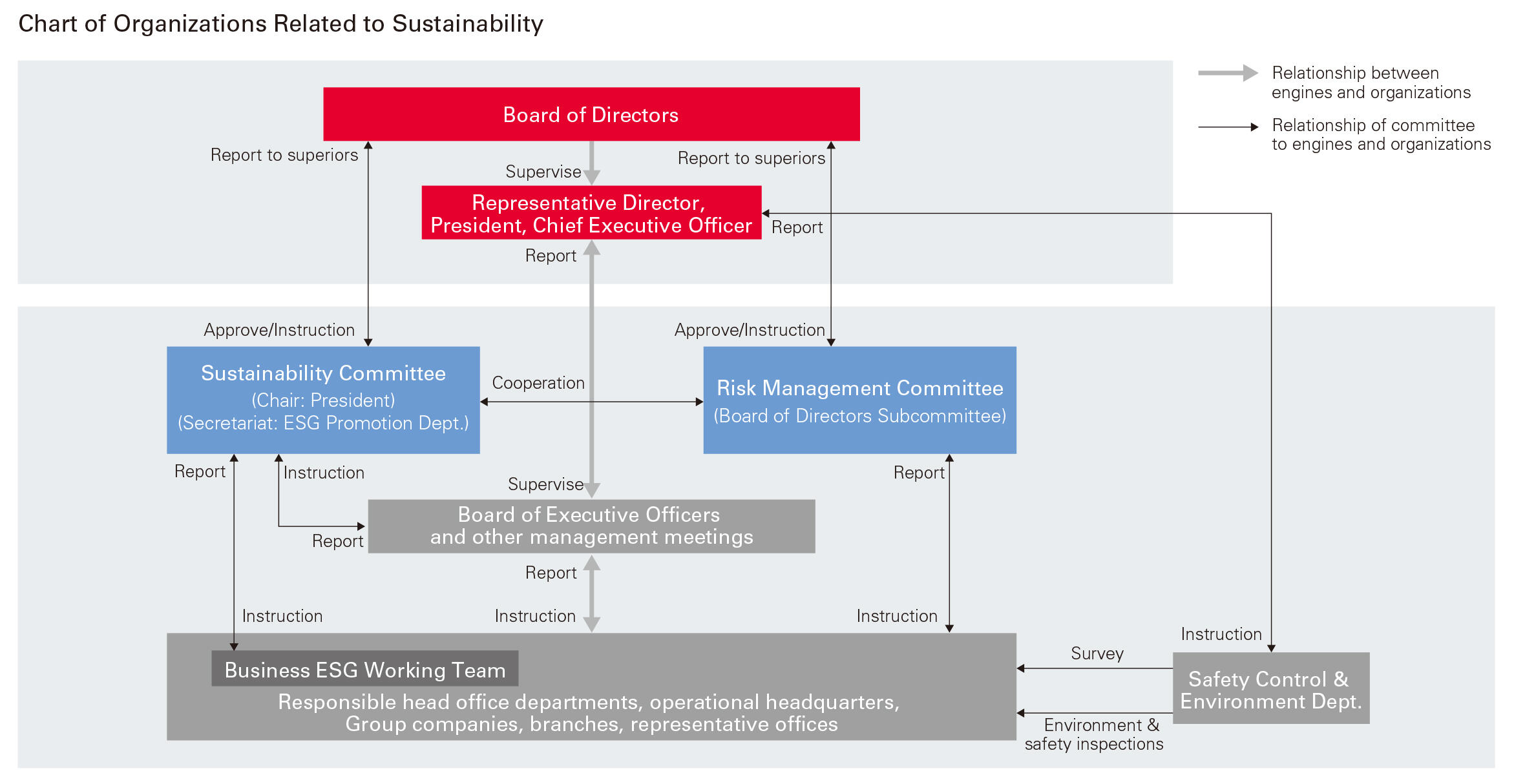
To strongly promote ESG initiatives aimed at realizing a sustainable society, the KYB Group has established a company-wide structure for planning and executing ESG strategies, with the ESG Promotion Department and the CN Promotion Section playing central roles.
As an organization that oversees the entire Company, we have established the Sustainability Committee, for which the ESG Promotion Department serves as the secretariat. The committee deliberates important sustainability-related matters. Items discussed by the committee are submitted and reported to the Board of Directors. In collaboration with the various committees and functional divisions shown in the chart below, the committee also works on formulating policies and activity plans, as well as providing support and follow-up for departmental initiatives.
Risks and opportunities related to climate change--and corresponding countermeasures--are examined by the Business ESG Working Team, which reports its findings to the Sustainability Committee.
For individual sustainability themes, the lead departments (functional divisions, business units, and plants) take on issues and activity plans reviewed by each expert committee, and promote initiatives in collaboration with relevant departments.
Going forward, we will continue to emphasize dialogue with stakeholders both inside and outside the Company, embed ESG initiatives at the core of our management, and contribute to the realization of a sustainable society.
Efforts Towards Internal ESG Initiatives
ESG management requires the proactive commitment of each employee. At KYB, we work to raise awareness by continuously sharing ESG-related information through internal newsletters and our intranet, including bulletin boards and other communication channels.
In addition, since FY2023 we have introduced ESG e-learning programs for all employees, providing opportunities to learn the fundamentals of ESG and the SDGs, as well as KYB's initiatives. In FY2024, the program achieved a 100% completion rate.
| Awareness building activities |
|
|---|---|
| Education for promoting understanding |
|
Response to TCFD
The KYB Group, recognizing climate change as an important issue that it must engage with, has endorsed the Task Force on Climate-Related Financial Disclosures (TCFD) in February 2023. We are working to grasp the risks and opportunities presented by climate change based on TCFD recommendations, reflect them in our strategies, actively disclose information, and thereby increase our corporate value.
Governance
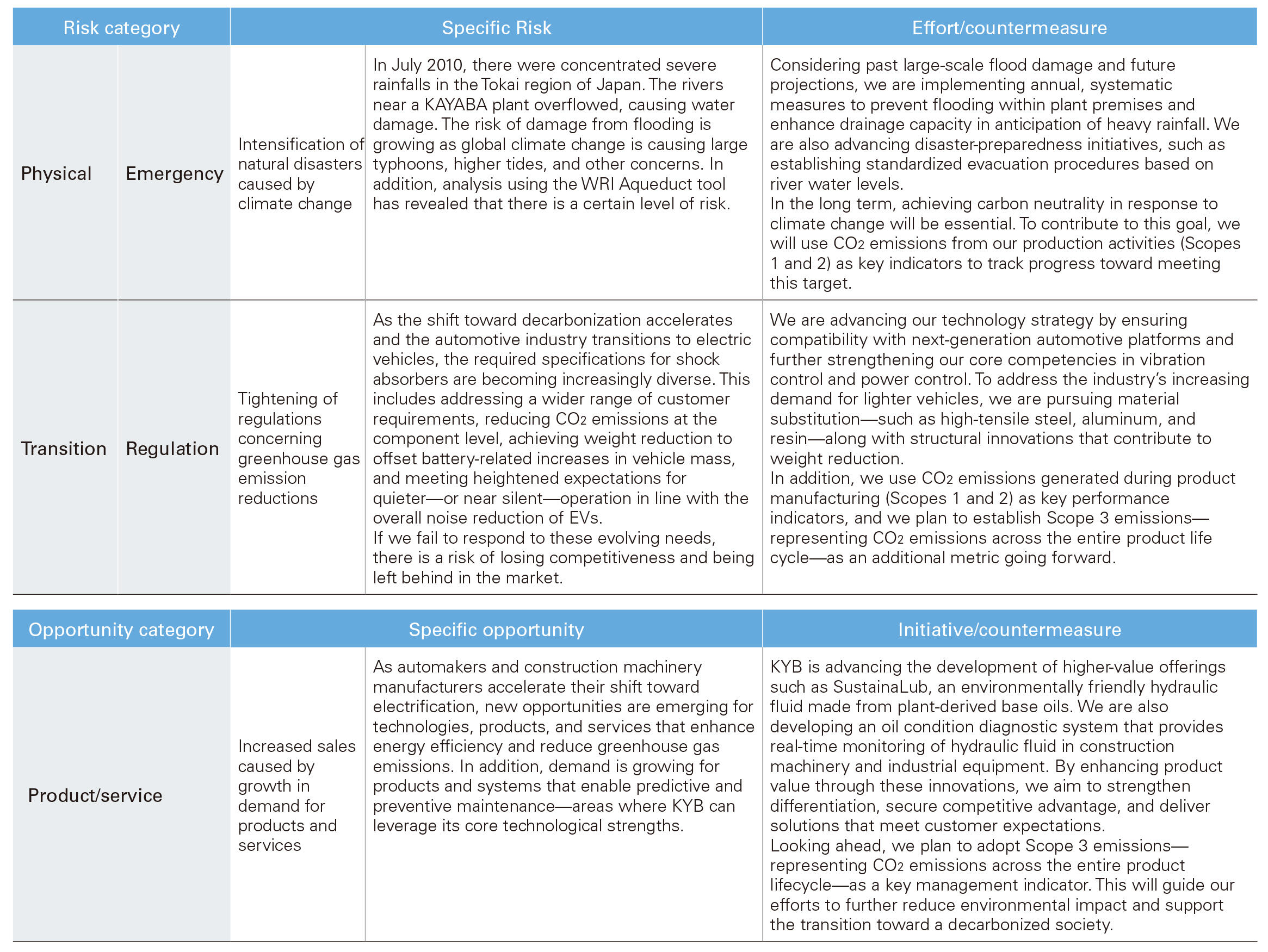
The KYB Group has set a goal of achieving carbon neutrality by 2050 and is actively working to reduce greenhouse gas emissions, implement measures to minimize environmentally hazardous substances contained in our products, and develop low‑CO₂ and energy‑efficient products. We define the degree of impact of climate‑related risks and the business opportunities arising from these impacts based on events that could cause significant financial consequences, such as decreases in orders or suspension of plant operations. These risks are classified by likelihood, magnitude of impact, and qualitative implications to clarify their potential severity. Furthermore, we evaluate these impacts through scenario analysis, as shown in the table below, and reflect the results in our business strategy and management plans.
Metrics and Targets
The targets and actual results regarding climate change for KYB and its subsidiaries' production bases are as follows.
| Index | Target | FY2024 (Actual Results) | ||
|---|---|---|---|---|
| Fiscal year | Numerical target | Results | Evaluation | |
| CO₂ total emissions (Scope 1, 2) |
2024 | 207,312 tCO₂ | 189,069 tCO₂ | Accomplish |
| 2030 | 138,578 tCO₂ | (Initiative ongoing) | ||
| 2035 | 80,375 tCO₂ | (Initiative ongoing) | ||
| 2050 | 0 tCO₂ Carbon neutral | (Initiative ongoing) | ||
| Renewable energy adoption rate | 2025 | 15% | 15.8% | (Initiative ongoing) |